![]() Image 1 of 1
Image 1 of 1
Dahlia-Delight – Puzzle
I started with the dahlia because it's a flower that doesn't do anything halfway. Layer after layer of petals, each one catching light differently. I wanted to build that depth with quilled paper, so every petal got rolled, shaped, and positioned to have its own dimension. The result is a flower that reads as fully three-dimensional even though it's flat on the wall.
The color story here was key. I used magenta as the dominant color, but I didn't stop there. I let the petals fade from deep hot pink to lighter magentas and even pale whites at the edges, especially on the outer ring. The center got that warm yellow-gold treatment with darker stamens in the middle to give the whole thing a focal point. Each petal has striations in the paper itself, which means the color shifts as you move around the bloom.
Then came the spiraled stem. I wanted something playful to balance all that structured petal work, so I created these loose, organic green coils that curve up both sides. They're quilled from narrow strips, so they have that delicate spring-like quality. The contrast between the tight, architectural petals and those wandering green tendrils is what makes this piece feel alive.
This is a finished dahlia, full and open, at its absolute peak. It sits centered and confident against the black background, which makes the magenta and whites glow. There's no apology in this flower, just bloom.
---
As a puzzle, the dahlia breaks into manageable regions. The outer petals with their soft pink-to-white fades are a meditative section, while the deeper magenta petals in the middle tiers give you more distinct pieces to work with. The yellow center is a warm focal point that draws you in as you build. The two green spiral stems on either side are loose enough to be their own satisfying challenge. It's a bloom that comes together gradually, layer by layer, just like the real thing.
I started with the dahlia because it's a flower that doesn't do anything halfway. Layer after layer of petals, each one catching light differently. I wanted to build that depth with quilled paper, so every petal got rolled, shaped, and positioned to have its own dimension. The result is a flower that reads as fully three-dimensional even though it's flat on the wall.
The color story here was key. I used magenta as the dominant color, but I didn't stop there. I let the petals fade from deep hot pink to lighter magentas and even pale whites at the edges, especially on the outer ring. The center got that warm yellow-gold treatment with darker stamens in the middle to give the whole thing a focal point. Each petal has striations in the paper itself, which means the color shifts as you move around the bloom.
Then came the spiraled stem. I wanted something playful to balance all that structured petal work, so I created these loose, organic green coils that curve up both sides. They're quilled from narrow strips, so they have that delicate spring-like quality. The contrast between the tight, architectural petals and those wandering green tendrils is what makes this piece feel alive.
This is a finished dahlia, full and open, at its absolute peak. It sits centered and confident against the black background, which makes the magenta and whites glow. There's no apology in this flower, just bloom.
---
As a puzzle, the dahlia breaks into manageable regions. The outer petals with their soft pink-to-white fades are a meditative section, while the deeper magenta petals in the middle tiers give you more distinct pieces to work with. The yellow center is a warm focal point that draws you in as you build. The two green spiral stems on either side are loose enough to be their own satisfying challenge. It's a bloom that comes together gradually, layer by layer, just like the real thing.
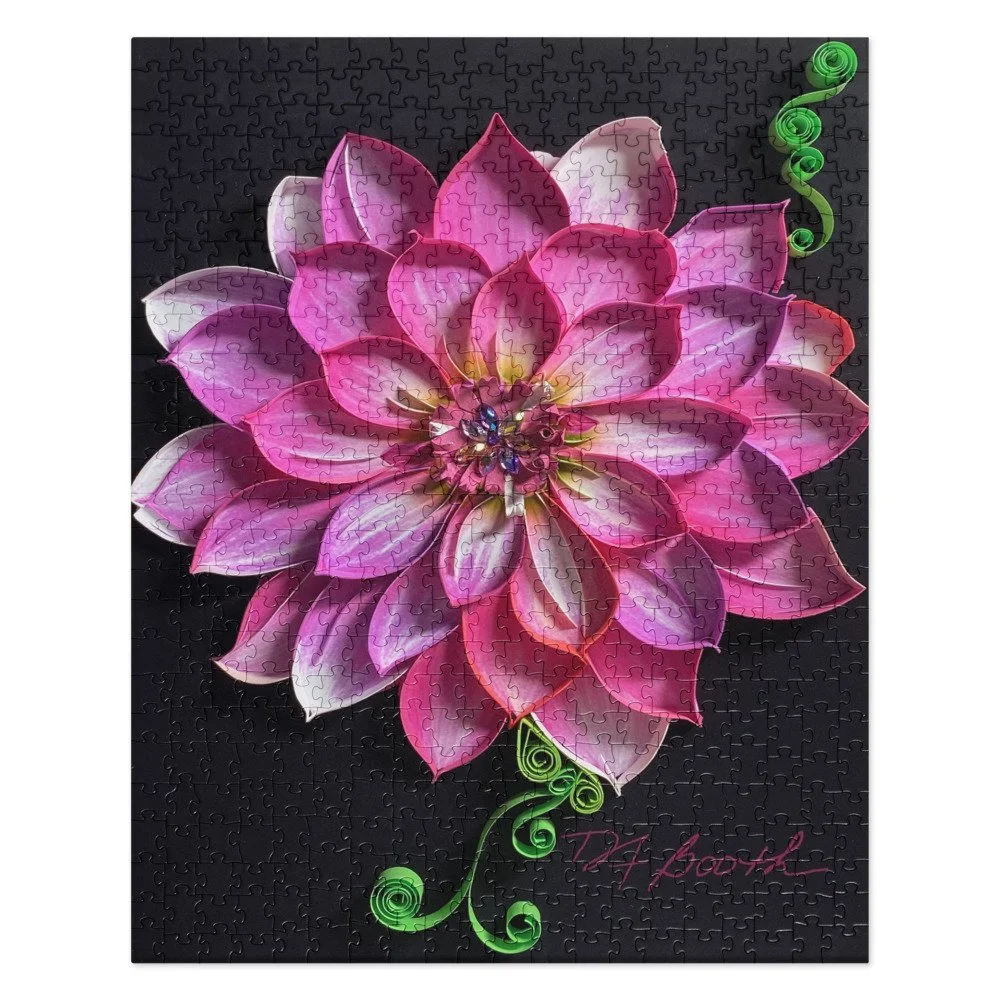 Image 1 of 1